
Effects Of Single Parents Dating In Usa
- Burned out and financially strapped, single parents are struggling during the pandemic. Jacalyn Shirley, with two of her three kids, had to adjust her work schedule to care for her children.
- According to Pew Research Center, the U.S. Has the highest share of single parenting in the world. In 2018, almost a quarter of U.S. Children under the age of 18 lived in a.
Research shows that single parenting affects both the parent and the children, and the effects can last long after the children become adults. Single parenting is when there is only one parent in the home taking care of the children. Most single-parent families are run by mothers with the exception of a few run by fathers. According to a study, single parents in the US reported higher levels of stress and anxiety compared to other households. These stressors can come from the effects of being new to the remote work setup or being unemployed, which are experienced more by single parents, as well as a decline in income and loss of employment benefits. Single Parents Rights for Single Moms: Struggling to make ends meet to look after her family, one of the biggest challenges for a single mom is coping financially. When a father doesn’t pay support, a single mom can apply to locate an absent father through the Department of Motor Vehicles and State Employment agencies and a single mom can.
In the 2006 film, “The Pursuit of Happyness,” Will Smith portrays Chris Gardner, a single father who manages to pull himself and his young son out of homelessness by becoming a successful stockbroker. The movie is based on a true story, and we learn early on what drives Gardner when it comes to his son: he did not meet his own father until he was grown, and he’s determined that his children are going to know their father. So when his son’s mother announces plans to move away, Gardner insists, “my son stays with me.” There are some tense moments in the film when it’s easy to question whether it might have been better for the child to go with his mom—like when father and son spend the night on the filthy floor of a train station bathroom. But as we watch Gardner work hard and care tenderly for his son, it becomes clear that there is no better place for the little boy to be than with his dad.
Since the film aired just over a decade ago, it’s become more common for children in single-parent families to live with just their fathers. According to a new report from the U.S. Census Bureau, 16.1% of single-parent households today are headed by fathers—up from 12.5% in 2007.
Overall, most U.S. children still live with two parents, while 27.1% live with one parent—most with their mothers, who still account for the overwhelming majority of single-parent families. Even so, as the figure below shows, the share of children living with a single father has increased from about 1% of all children in the 1960s to 4.35% in 2017.
In an email, Christopher Brown, president of the National Fatherhood Initiative (NFI), told me that the rise in single-father families can be attributed to two cultural factors: 1) “Men are seen as more capable parents, in general, and accepted as single fathers, specifically,” and 2) “A greater willingness of the courts to award custody to single fathers—essentially awarding custody to the best parent, regardless of gender.”
So, what are some of the characteristics of today's single dads? Here are five facts about single-father families that provide a glimpse into who they are and how they differ from single-mother families.
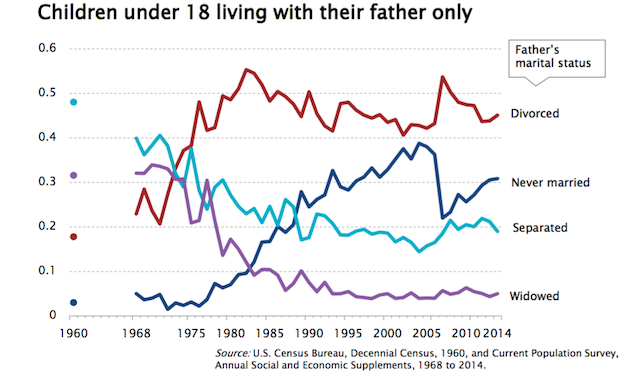
1. Most single fathers are divorced. As shown in the Census figure below, the majority of children living with their fathers only are living with divorced dads, although the share who are living with never-married fathers has risen in recent years. By comparison, most single moms (49%) have never been married.
2. Single fathers are more likely to be white, older, and somewhat better educated, compared to single mothers. According to a recent report on single-parent families by the National Center for Family & Marriage Research (NCFMR), 56% of children living with single fathers identify as white,” compared to 33% of children living with single mothers.
Furthermore, the NCFMR reports that single fathers are slightly more likely than single moms to have at least a bachelor’s degree (23% of single dads vs. 18% of single moms) and to have graduated high school.When it comes to age, single dads also tend to be somewhat older than single mothers.
3. Single fathers are more likely to be cohabiting. A 2013 profile of single fathers by the Pew Research Center found that 41% of single fathers were living with a cohabiting partner, compared to 16% of single mothers. The report notes:
Cohabiting single fathers are particularly disadvantaged on most socio-economic indicators. They are younger, less educated, and more likely to be living in poverty than are fathers who are raising children without a spouse or partner in the household.
Single Parents Meet
4. Single father-families are better off financially than single-mother families. For example, Pew reports that the median-adjusted annual income for a single dad with two children is about $40,000, compared to $26,000 for a single mom with two children. Moreover, the share of children living in poverty is about twice as high among those living with single mothers as those living with single fathers. Although single fathers are less likely to be living in poverty than single mothers, they are still significantly more likely to be living in poverty than married parents: 8.4% of related children in married families were in poverty in 2016, compared to 19.9% of related children in single-father families, according to the latest Census report.
5. While the research on single fathers is limited, studies show that children in single-father families fare about as well as children in single-mother families on many outcomes, although there are differences. In aliterature review of research on single-fathers dating from the 1970s through 2015, Roberta Coles concluded that compared to children in single-mother families,
With a few possible exceptions, the children of single fathers do about as well in terms of internalizing behavior and academic performance (sometimes better)… However, the children of single fathers appear to be more likely to participate in externalizing behavior and substance use … As of yet, the few studies of young adults (as opposed to adolescents) do not seem to indicate significant long-term differences, as related to marriage, teen birth, and divorce, between those reared in single-father versus single-mother homes.

A study by Child Trends researchers published in 2010 used a sample of nearly 4,000 adolescents from the National Longitudinal Survey of Youth to study the characteristics of single-father families and the “effects of fathers’ involvement and parenting on outcomes” like graduation from high school. This study was unique in that instead of grouping cohabiting fathers with lone fathers, it distinguished between them. Among the study’s findings: cohabiting single-father families had fewer family routines, like eating dinner together, and single fathers who were living with a partner “had lower levels of closeness and awareness than did parents in all other family times.” The authors concluded that “offspring who reside with a custodial father and their cohabiting partner may face additional challenges and unique circumstances that cannot be fully explained (mediated) by differences in father involvement and parenting styles.”
Finally, a more recent study published in November in the Journal of Family and Child Studies used data from the National Longitudinal Study of Adolescent to Adult Health to examine sexual behavior among 15-to-19-year-olds being raised in single-parent families. The authors compared various sexual behaviors (including intercourse, contraceptive use, and attitudes toward pregnancy) among boys and girls living with either single mothers or single fathers. Surprisingly, they found “few differences” on these sex-related outcomes between teens living with single moms or single dads.
Single fathers represent a unique and growing share of single-parent families for children. While they differ in important ways from single mothers, Brown emphasizes that “single dads need some of the same supports.” This includes “assistance from the other parent, if that person is in the family picture, to raise their children as effective co-parents, and [when the child’s mother is not in the picture] from family members, friends, and their network (e.g. faith community and direct-service nonprofits) in raising their children.” Because single-father families are more likely to be in poverty than married families, they also benefit from access to government services and aid. Finally, single dads need more community-based and online support groups and resources that are geared toward the needs of fathers, not just single mothers (NFI provides a list of resources for single dads here).
Alysse ElHage is editor of the Institute for Family Studies blog.
Editor’s Note: The views and opinions expressed in this article are those of the author and do not necessarily reflect the official policy or views of the Institute for Family Studies.
“I never really had an opinion about my mom dating, other than I feel sorry for the guys who gave up on the most amazing woman I know.” -16 year old
Dating and parenting can be a difficult adventure to navigate. I always wonder what my kids are going through as they watch their mother date. I have been curious if being a single parent was as common and “normal” as we are told it is. I asked my own kids, “how did growing up with a parent in the dating world affect you?” they answered along with a pool of others who, behind the cloak of anonymity shared their own experiences. In short, what I found is quite intriguing.

Starting with how difficult it actually was to find young adults who remember one or both of their parents going through the dating stage. With divorce rates at 50% and up, it seems to make sense that all kids of divorce would witness this. I was so incredibly wrong. It turns out in fact, the majority of young adults asked, responded simply by saying their parent’s re-married/re-coupled when they were very young. They don’t remember the dating phase.
After letting that percolate, I guess it makes sense to me. In the past, I have had a hard time dating because I specifically didn’t want to date anyone with small kids. I made concessions to that rule two times for separate serious relationships. When the men chose to end the relationships, I didn’t only lose the guy I also lost the children; three kids have called me “step-mom” even though I wasn’t married to their fathers. Two boys that I lived with for a short time, and one beautiful little girl; I’ll never get to see those kids again. For a plethora of reasons including my experiences, in my dating world someone with small children is an automatic no.
My own kids are past the “little kids” phase. They are 16 and 21 and have had to learn some very hard lessons growing up with a single mom. Both of my girls have trust issues that stem from the unfortunate amount of men who decided after the relationship had reached the “serious” level, that they just didn’t want to be in a relationship. Always ending with the “it’s not you it’s me; I just am no good at love.” If I could go back in time and foresee the results of those relationships, of course I would have never chosen to allow my children to go through that. However, no one enters a serious relationship planning for it to fail.

“From childhood, I've always had this feeling that nobody stays. Nobody cares, and nobody will make me a priority...Each time my mom was left, broken up with or ignored I felt that with her. I watched each friend and boyfriend leave sometimes for no reason other than they just didn't feel like sticking around anymore. ” -21 year old
“I guess today that's why I'd prefer to be single because I grew up watching my mom get hurt and strung along.” -20 year old
The perplexity became oddly clear to me; these young adults were all speaking about their mothers dating. The dads in all of these situations either re-coupled very quickly or simply abandoned the child for a new life. I am very aware that there are good men still out there, trying to date while navigating parenting, I just personally didn’t run into any of them while conducting research for this article. The one person who mentioned her father dating had this to say,

“My father has been married twice, both ended in divorce and engaged twice more after that. Each of the women he's had romantic relationships with, he talks badly about and labels most, if not all, 'crazy.' Being his child, from a young age I knew he wasn't the nicest person and their, 'crazy,' was probably in reaction to his rudeness and sometimes emotional abuse. This affected me in the way that for a long time I wasn't aware of my own toxic behavior, and that lack of self-awareness truly caused some turmoil in all my relationships; romantic, platonic, and familial.' -20 year old
Where does that leave us with regards to the actual affects dating has on your children? I’ll let them speak now, as young adults.
“Even though we've had that hurt over and over, we've always had each other. At the end of the day, the people that have come in and out of our lives has taught me that family (chosen or blood) will always be the most valuable friends.” -21 year old
“There were a lot of trust issues developed over those years of watching so many men hurt my mother's heart, but her strength of never giving up and forever seeking true happiness helped me realize that she was and is a strong woman.” -22 year old
“This taught me to jump from relationship to relationship, and never take my time to truly get over someone before already trying again. She never got that time to find herself and now in her mid-forties is going through her soul searching that one would experience in their early twenties.” -20 year old
Each of these young adults said they never talked to their peer groups and friends about what it was like to have a parent dating. Some said it was out of fear of judgment, others said peers that had two parent homes surrounded them. Each of them felt alone in their feelings and none of them knew how to talk about their feelings.
We need to continue to teach our kids that we aren’t just their parents. We are real live people with real live feelings and emotions. I am not just mom. I am also, Jessica. Kids need to see the reality that their parents are in fact, humans. Speaking to them about things that are going on in their lives is a no brainer. Starting to talk to them about their feelings at a young age will help to keep the doors of communication open. However, when was the last time you let your child have some insight into your own life? Of course, I am not in any way implying that your child should know every gory detail of every Tom, Dick and Harry you date. Have you ever allowed yourself to be vulnerable in front of your children? For trust to exist, transparency needs to co-exist. This applies to all relationships, even that between a parent and a child. Talk to your kids. It may be awkward at first, but let them know what they are feeling is valid. Make sure they know they aren’t the only ones going through the issues that come with parenting and dating. More important than anything else, make sure your kids know they can trust you and talk to you.
“Quite frankly my experience, although tough, was a lot easier than most people's. Because my parents openly communicate with us and don't lie to us or hide things from us, we can all be truthful about how we feel. And when you put your feelings aside and stop looking at your parents as robots whose only objective is to parent you and see them as people who want love and their own lives just like you do, then it becomes so much easier to understand' -21 year old
*Disclaimer: I am not a counselor, doctor, or professional of any kind. I am simply a woman who has made enough mistakes and learned enough lessons to share those with others. I may not always know what to do, but I certainly have learned what not to do.